Monday, January 4, 2016

Happy New Year 2016

I hope this first post of 2016 finds you well and happy.  I apologize for the long absence of posts, but with any luck at all, I will find myself back on track.

It seems the thing that most people do at the beginning of each New Year is make New Year’s Resolutions.  What is a resolution?  Well, from my own perspective it is a promise that we all make to ourselves and then break at some point during the year, just to make the same resolution at the beginning of the next year.  You know I am right on target!

With that in mind, I am not making any resolutions for 2016, I am just going to keep plugging along in life.  I will continue to go to work each day, I will continue “Searching for Ancestors”, I will continue to post items to my blog (even if I miss some weeks, or even months), I will plan a vacation (if I don’t get to go since for the last three (3) years, work has got in the way), and I will continue the everyday mundane tasks of cooking, cleaning and grocery shopping.  I will also continue to transcribe documents for the Northwest Missouri Genealogical Society so they can get more indexes out on their website (this is my way of volunteering a little bit of time to help others).  Doesn’t that sound more like the truth than making a resolution that won’t be kept?

Some things I have planned for this New Year including adding a page to my blog with all the surnames I am researching.  I also want to retake pictures of all tombstones associated with my family, and that will include going new places to get new pictures.  I will also try to locate new documents in new places instead of relying on the Internet, since we all know that all documents are not on the Internet, yet.

I wish you luck in the New Year and hope you stick to your resolutions.  As for me, I will continue “Searching for Ancestors”.

Saturday, October 31, 2015

Podcast? What In The World Is That?

I have been asked, "Where do you learn how to do genealogy"?  Well, I read a lot, I ask questions of others (those in the know), I attend conferences and I listen to podcasts.

Podcasts are nothing more than a person who has taped themselves and/or others and provide information to the listening audience.  There are podcasts on all types of subjects, including genealogy.  The one I listen to the most is Lisa Louise Cooke and she is the producer and host of the Genealogy Gems Podcast.  She is also an author of some of the best genealogy books I have the pleasure of reading and she is a conference speaker whom I have personally seen.  She has a terrific website and offers both free and premium (subscription) podcasts.  The premium version also includes how-to videos and handouts.  She has a few free videos available also.

Her website can be found here.  The following infographic was put together by Lisa and explains more about what podcasts are.  I hope you check out her website and catch a few podcasts.  They are so informative and you will learn a lot from her.  She is one of the top people in the field of genealogy and she is an expert on how Google Earth can help with your genealogy as well as tons of other genealogy related subjects.


Saturday, October 17, 2015

10 Shots Fired in Holdup Fray

The following newspaper article is about Ben E. Mann.  Ben was married to Willa Isadore Main, who is the daughter of Jason Archie Main and Willa Ruth McCarthy.  Jason is a brother to Cora Viola Main, otherwise known as Grandma Scott (to me) – my mother’s mother.  That relationship makes Isadore (the name I knew her by) Grandma Scott’s niece.

The Kansas City Times (Morning Kansas City Star)
Friday, November 3, 1961, Page 1, Column 1

10 SHOTS FIRED IN HOLDUP FRAY
Crowded Store at Truman Corners Is Scene of Robbery Attempt
FOILED BY A DEPUTY
Ben E. Mann, 51, Wrestles One Man, Shoots at the Other

            An off-duty Jackson County deputy sheriff wrestled with one holdup man while he fought a gun battle with another in a crowded Katz drugstore in the Truman Corners center last night.
            Ten shots were exchanged, four by the officers and six by the robber, at a distance of 10 to 15 feet.
            The deputy, Ben E. Mann, 51, said he thought he hit the robber twice.  Mann was not hit.

Saw the Man Fire.

            “I don’t know how he missed me”, Mann said, “I saw him kneel down behind the counter and fire from between the shelves”.
            The shoppers in the store started screaming and running when the shooting broke out.  None was hit.
            The deputy, not in uniform, but carrying a snub-nosed pistol beneath his jacket, had gone to the store to buy some dog food.  A member of the sheriff’s patrol nine years, he works in the store as a store detective during the holiday seasons.

Warned by Official.

            Mann was standing by the prescription counter when George Stanley, Belton, assistant manager of the sundries department, walked past with another man behind him.  As he passed, Stanley, who is tall, leaned over to the shorter deputy and whispered:
            “Mr. Mann, this man has a gun on me to rob the store”.
            The deputy drew his pistol and ordered the robber to take his hands out of his pocket.  As he did this he was struck on the head with the butt of a gun by the second robber.
            A pharmacist, John W. Broyles, 11111 Bristol avenue, described what happened:
            “The man pulled the gun out as if he were going to shoot and changed his mind, flipped it over in his hand, and hit Mann a light blow with the butt.”
            The blow jarred me for a minute”, Mann said, “and it gave this man [in front of him] enough time to get his gun out of his pocket.  I grabbed his gun and held it down away from me”.
            Mann, holding one man’s gun hand down with his left hand, turned on the other gunman, who dashed behind a display case and started shooting.

Hits Glass Display.

            Mann’s first shot shattered a display of glass behind the robber.
            Then the robber moved to his right and fired two or three more times, the deputy said.  Mann said he was sure his second shot struck he robber in the abdomen.  A small spot of blood was found near the front door after the men dashed out.
            The robber and the deputy exchanged shots again.  Mann said he believed he had struck him a second time.
            All this time the man he was scuffling with kept repeating:
            “Don’t be a fool.  There’s three of us.  There’s somebody coming up behind you”.
            Finally the robber who had been firing at Mann dropped to one knee and took careful aim over the counter top.  He missed again and the officer fired back.
            Someone shouted at Mann, “Look out behind you”.
            When I heard that I figured it was the time to let go”, the deputy said.  The two robbers dashed out the front door to a 1956 blue-and-white Ford in the parking lot.
            Stanley ran behind the prescription counter when the shooting started.
            “I came out to help Mr. Mann, who was scuffling with the man”, he said, “and the other man drew a gun on me so I ducked under the counter”.

Started at 8:45.

            Stanley said the two robbers accosted him about 8:45 o’clock.
            One man, the one who fired, wore a suede jacket, a billed cap, and had a flesh-colored bandage on his nose.  The other had on light gray trousers, a jacket and carried a rolled up paper shopping bag which dropped on the floor in the excitement.
            “This man stopped me in the store and asked me if I was the manager”, Stanley said.  “I said no, but he showed me his gun and ordered me to the back of the store.  On the way, he told we were going to open the safe”.

Picture included with Newspaper Article


Sunday, October 4, 2015

Genealogy Do Over

What is a “Genealogy Do Over”?  Well, it is a learning program that I have been following.  A very well-known gentleman in the genealogy community has provided information on how to “do” genealogy correctly, such as citing your sources (which is the biggest failure that we have all done) to research strategies, organization, providing forms to help with your research, etc.  His name is Thomas McEntee and he has a group on Facebook specific to the Genealogy Do Over and can be found here:  https://www.facebook.com/groups/genealogydoover/.  You can also check out the following page on his blog where he further explains what this is about and why he started this group:  http://www.geneabloggers.com/tag/genealogy-do-over/.

On the Facebook page if you look under the "Files" tab, there are the weekly things to "do over" with your genealogy all listed in PDF format per week.  This is a 13 week plan that is now in its 4th Cycle for the year.  It is currently on Cycle 4, Week 1 so this is a great time to check out the information.  There are also free forms to download (submitted by both Thomas McEntee and the people that are following his “Do Over” plan).  The Group provides you a chance to ask questions about, as well as learn information about, the different aspects you are presented with for each week.

This is what Thomas McEntee put on his blog which kind of explains what the Genealogy Do Over is all about:

“Back on 15 December 2014, I made a big announcement: I was getting rid of 20+ years of past genealogy research and starting over. Some people said I was crazy. Some people said the idea was just “stupid” and wasteful.
But almost 10,000 genealogists and family historians have either been actively participating in this crazy project or have followed it over at the Genealogy Do-Over Facebook Group. Many have said that they finally have a methodology and format for research that they can live with AND that can bring them results.
Still more have taken the collaborative effort to heart and have shared their own work, their own templates as well as tips and tricks. The Genealogy Do-Over has been as close to a “genealogy hack-athon” and an exercise in group problem solving as I could want.

With all of the organization I have been doing as a result of this project, I can now find things instead of spending hours trying to locate information in different areas of my home.  I only have one (1) more family line to fill out Family Groups Sheets on in an effort to see what types of information I don’t have so I can more easily find that information  The family I have left  is the Scott side of my family (my mother’s ancestors).  I have located information on the Internet going back several generations, however, we all know not to take the Internet for granted.  I will need to prove the existence of each of those family members and try to locate their birth, marriage, and death information to try and prove that connection.

Please head on over to Thomas McEntee’s Blog or Facebook page and I highly suggest joining his group on Facebook if you want to learn how to do genealogy correctly the first time so you don’t end up like me.  I had information spread all over the place that contained no source citations and couldn’t find any documents I needed when I needed them (and of course couldn’t find the place where I got that information since the source citation wasn’t listed).  Source citations are used in an effort to allow others to find your information for themselves should they look at or copy your documentation.  Documents with source citations are considered “facts”.  Documents without source citations are considered “possible facts” which need to be explored further by a genealogist to find “facts” (and make sure you provide source citations to those documents when you find them).

Some documents and sources are considered “Primary” and others are considered “Secondary”.  Primary sources are those documents that were created by someone who was at the event when it happened (Birth Certificates, Marriage Certificates, diary pages, etc.) and Secondary sources are those documents where someone different supplied the information (such as Birth Date and Place of Birth on a Death Certificate).  Most likely, the person supplying that information was not there at their birth and only provided information they were “told”.  That documentation needs to be supported by other documentation (preferred Primary source) to be considered “fact”.

I digress, and I apologize.  I have learned so much from the genealogy community and I enjoy sharing my knowledge.  I wish you the best of luck in your search for ancestors!  I will continue “Searching for Ancestors” myself when the opportunity arises, and will post information as I locate it.

Sunday, September 27, 2015

Growing Up in Hume, Missouri

Guy Calvin Scott and Cora Viola Main (my maternal grandparents) lived in Hume, Missouri both prior to and after they were married.  I am unsure when they moved away from Hume, however, I do know they lived in North Platte, Nebraska in 1958.  I had some general questions about growing up in Hume.  About a year ago, I had a chance to ask one of my living uncles some of those questions.

Me:  Do you remember how many acres of land you had?
Uncle:  We had 80 acres.

Me:  Did you remember what kind of livestock you had?
Uncle:  We had hogs, cows and chickens.

This discussion brought back other memories that my uncle shared with me so very few questions were asked after that.  The stories just started flowing, and I started writing.  When I refer to “my uncle” in the following stories, it is my living uncle who provided them.

My uncle said he rode a horse to school in the 1st grade because they lived about 5 miles from the school.

My youngest uncle once traded a sick chicken for a bag of flour for his mom (Cora Viola Main).

My uncle would shoot rabbits because he could sell them for .25cents and a box of shells was .35cents, so if he shot two (2) rabbits, the extra money was “gravy”.

My uncle would trade a chicken for a bologna roll.

There was no running water in Hume.  They had a well that they would pump water from.  Their well would go dry every year, but would seep enough water at night to water the animals the next day.

Guy’s father (Thomas Green Scott, my great grandfather) would sit on the porch while the rest of the family tended to the farm.  My uncle said he had heard stories from him about how good he was at farming and how fast he could get things done, but never saw him help out any.  He was disappointed that when help was needed, Thomas would not pitch in and provide any.

One day, Thomas and my uncle were talking outside when a bird flying overhead decided to poop.  The poop fell straight into Thomas’ shirt pocket where he kept his chew.  Thomas calmly went inside the house, got a rifle, came outside and started shooting birds out the sky.  This story caused great laughter from both of us!

These are the type of family stories I enjoy listening to.  I can only hope that I am able to get more stories like this in the future.  I have no older family members on my paternal side still living, however, I am happy I am able to learn things like this from my maternal side of the family.

Sunday, September 13, 2015

Memorial Service For Dad

Jerry Eneau Modrell was born April 27, 1928 and left this life on December 25, 1999.  He lived in Pharr, Texas at the time and I drove over 900 miles to be with him when his Doctor said it was time to come down as he was deteriorating quickly.

There was a funeral in Texas, but the only person I knew there was my stepmother.  It was very impersonal for me and I was in shock and don’t remember much.  She had him cremated, which is not what I wanted, however, it worked out for the best as his ashes are now with me and I don’t have to go over 900 miles to “visit” him or lay flowers.  He is right here with me at all times, which has provided me with comfort over the years.

I decided to hold a Memorial Service for my dad on April 27, 2000, which would have been his 72nd birthday.  I wanted something a little more personal that would provide me a chance to say some good things about the man who raised me.  I had been struggling in a bad way since his passing.  At that service (which was very small and informal), I decided to speak about my dad.  The following words were spoken at the service:
  
“When my dad laughed, his whole face would light up.  When he was mad, the whole world could see it.  His face would curl up and that finger would start pointing.

My dad was also my mom during my growing up years.  I think he did a great job.  He was the #1 man in my life.

His favorite story to tell was one dealing with his childhood.  He wanted one of those red pull wagons real bad.  Grandma and Grandpa Modrell couldn’t afford a red one, but they did buy him a blue wagon for Christmas.  He was really disappointed but promised himself that someday, he would have a little red wagon.  He kept that promise and in 1971 he bought a brand new Ford Stationwagon.  Red.  He told everyone that he finally got his little red wagon.  To expand on the story, in July of last year I started driving him around to look for a car.  We went everywhere, but nothing was just right.  The big truck he had was getting to be too much to handle for him and too hard to get in and out of.  One day I called him from work to make plans for dinner.  He told me he bought a new car today.  I asked what he got.  For about the next 20 minutes, all he could say was, “I bought a little red wagon”.  “A Stationwagon?” I asked.  “Nope, I bought a little red wagon”.  “A Navigator?” I asked.  (That is what he really wanted).  “Nope, I bought a little red wagon”.  I guessed everything, or so I thought.  Finally he said, “Does a Sedan Deville mean anything to you?”  I said, “You bought a Cadillac?”  He said, “I got my little red wagon”.  It was a beautiful car and he was so very proud of it.  When he passed away, he was still the proud owner of a “little red wagon”.

My dad loved to read.  He read every day.  When I was growing up in the early to mid 70’s, we got a new set of encyclopedias.  I remember my dad reading them.  He read the whole set from A Page 1 to the last page in Z.  He read all the time.  He loved learning and he learned by reading.

My dad loved to travel and we went on vacations often as I was growing up.  When he retired, he went on the road for good.  He would always say, “In 1986, I got married, retired, threw up my hands and ran away from home”.

My dad knew everything.  He could also fix anything.  Okay, there were two (2) exceptions.  He let me borrow his 35mm camera the summer before I started photography at Vo-Tech, just to get used to it.  It had to have been the first one out on the market.  It was ancient.  One day it just quit working in the middle of a roll of film.  He said he’d fix it.  He took it apart.  He had the little parts neatly arranged on paper towels lining the top of this desk.  The problem?  With 10 billion parts, he couldn’t get it back together.  The other exception was a lawn mower that also had to have been the first motorized one on the market.  One spring it rained like crazy and the grass grew and grew and grew.  I tried to cut it before he came back for the summer.  I blew the engine, but only half way.  When he “fixed” it, it completely blew.

My dad loved life.  He also loved his family, antique vehicles, the trucks he owned, and the Colorado Mountains.  He also loved sweets.  His favorites were tootsie rolls, Oreo cookies, 3 Musketeers bars, Hershey Kisses, pinwheel cookies, hostess cupcakes, and banana cream pie.

My dad was diagnosed with cancer in July 1998.  He had several surgeries, but they couldn’t get it all.  He went through radiation and we were hopeful.  He thought he could beat this thing.  He fought the good fight for a year and a half.  He never complained of pain, he would just say he was uncomfortable.  In the end, the cancer won.

My dad was everything to me and I miss him terribly.  Happy Birthday Dad, I Love You.”

Sunday, August 23, 2015

The "Good Old Days"?

I found this interesting article on the Internet today.  I always wondered what life was like in the “good old days”, but after reading this, was it really the “good old days”?  You have to wonder.  I hope enjoy this article, it can found here:  http://historyhappenshere.org/archives/7698.


Missouri Listory: 10 Reasons the Gilded Age Wasn’t So Gilded

19, June 2015
We are introducing a new column called "Missouri Listory," which explores our vast historical collections and features them in lists of wide-ranging topics. Our first post in this column was inspired by our current exhibit, A Walk in 1875 St. Louis. Although the era was known as the Gilded Age, we bring you 10 reasons why living in 1875 wasn't so wonderful.

1. 72-hour work weeks
Not only was it common to have such a demanding schedule, but also you would have been grateful to have it! The average work week for a laborer in 1875 consisted of six 12-hour days, with Sundays off. Most unskilled or semi-skilled workers toiled for about 20 cents an hour (about $4.45 today), and 9 out of 10 Americans died without any substantial property to pass on to family.

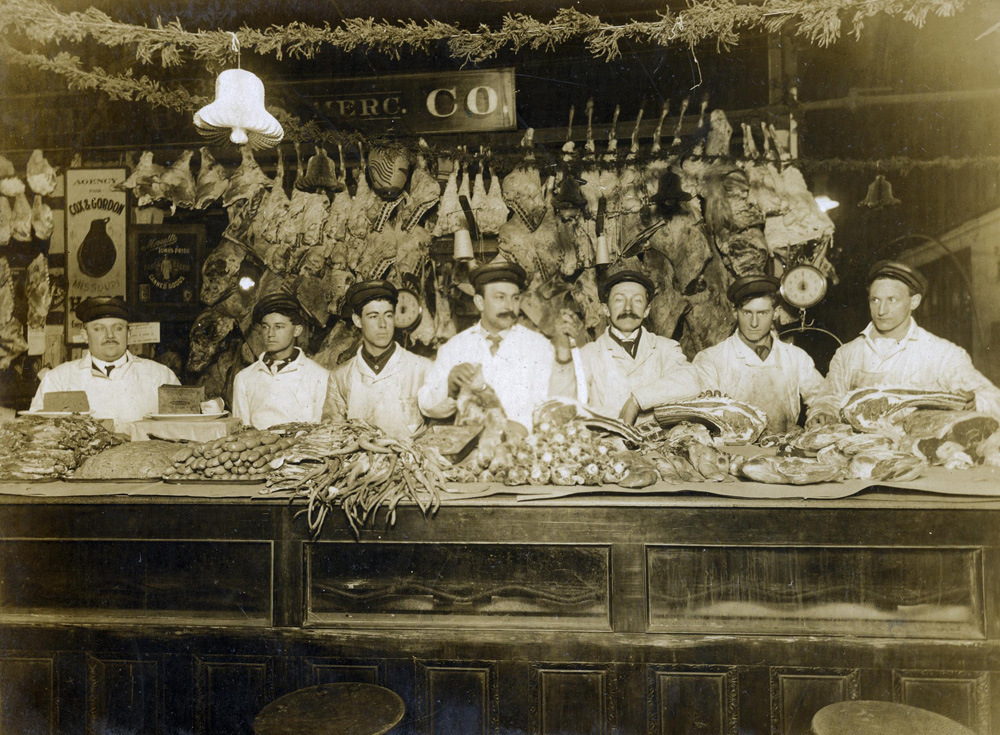
meat vendors in the early 1900s
Meat for sale on a counter in St. Louis, early 1900s. Missouri History Museum.

2. “Fresh” was a loose term.
In 1875, St. Louis police seized more than 57,000 pounds of meat that was moldy, diseased, or rotting from market vendors who were still trying to sell it. One in 20 pieces of meat for sale in St. Louis markets had a living parasitic worm infestation. Without refrigeration, meat rotted just hours after an animal was butchered. St. Louis Ladies Magazine recommended immediately searing the outside of any purchased meat to make it last a day or so longer.

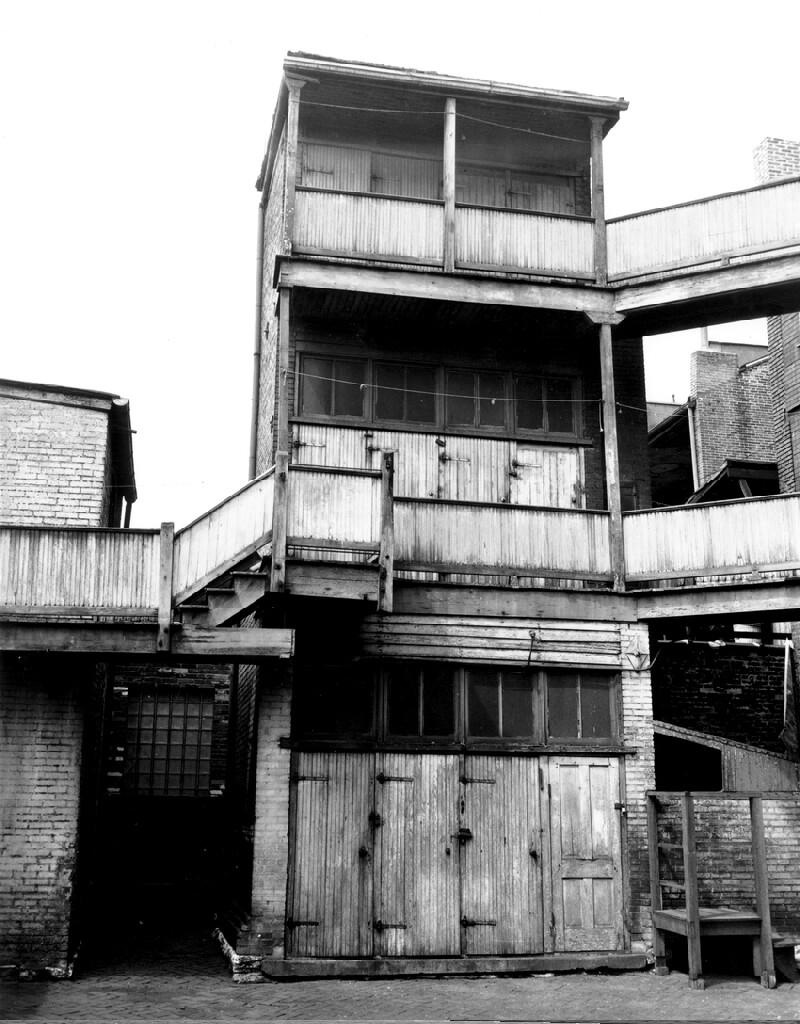
photo of 3-level outhouse used by 12 familiesThree-story outhouse shared by 12 families. Missouri History Museum.

3. Fewer than 1 in 5 homes had indoor toilets.
When nature called for the other unfortunate folks, they trudged out to their rickety backyard outhouse, which was sometimes shared with other families. These outhouses were often mere feet away from the family’s backyard well, which served as their source of drinking water. St. Louis health officer Arthur Barrett referred to backyard outhouses as “temples of indecency.”

4. In the late 1800s it was estimated that 10% to 15% of the American population had syphilis.
Need we say more?

5. The wafting aromas of Schaeffer’s Soap and Candle Works…
If you’re thinking of the pleasant scents wafting from a cozy candle store, think again. Schaeffer’s Soap and Candle Works at Washington Avenue and 20th Street was such a powerful punch in the nose that 1875-ers refused to build their homes within blocks of the company. The plant took in dead animals, bones, leftover food from hotels, and spoiled meat from butcher shops, then boiled it all together to extract tallow—hardened fat that is solid at room temperature—for candle making. Schaeffer’s was just one of many factories contributing to the unfathomable stench drifting over 1875 St. Louis.

6. Hurt on the job? Tough noogies, pal.
1875 St. Louis was a world with no Social Security, Medicare, health insurance, workers’ comp, or retirement plans. Dangerous low-wage labor jobs came and went daily and getting injured likely meant you were out of a job with nothing more than a kick out the door. Many a family fallen on hard luck wound up in a single-room tenement.  It may have been the most terrifying time in their lives.

Men standing in front of a saloon in St. Louis in 1897Men standing in front of a saloon at Gravois Avenue and Kingshighway. Photograph in 1897. Missouri History Museum.

7. Walking into the wrong saloon could quickly cost you more than a drink.
The 1875 St. Louis City Directory lists nearly 1,200 saloons (one per 100 drinking-age men), and some were certainly not for the faint of heart. They attracted a rough cast of characters that included thieves, gamblers, prostitutes, fortune tellers, and drunkards, and they were known to be a great place to go if you wanted to get in a fight or have your pockets lightened. An 1875 contemporary said of the riverfront saloons on Almond Street: “The luckless stranger that falls into these social pits may consider himself quite fortunate if he gets out without broken bones.”

8. Tricksters prowled the city looking for naïve “greenies.”
1875 St. Louis had no shortage of swindlers trying to fool “greenies,” as rural folks new to the big city were known. In May 1875 a trickster made more than $5,500 by selling fake property in an imaginary town called Vineland, Illinois. He claimed the town needed residents and if St. Louisans just paid a $2.25 notary fee, a lot in Vineland would be theirs. He sold 2,500 phony lots over three days and then vanished, never to be seen again.

a dental extraction kit from the 19th centuryDr. Hezekiah E. Depp's dental extraction kit containing picks and pliers. Missouri History Museum.

9. Dr. Hezekiah E. Depp’s Dental Kit
If a trip to the dentist strikes fear in your heart today, be glad you were not alive in 1875. Without electric tools, sterilization, numbing agents, or anesthesia, the dentist’s office was the definition of dread. Preventative dentistry was almost nonexistent, and the cure-all for any tooth problem was extraction. This dental kit displays 145 picks, pokers, and pliers used by St. Louis dentist Hezekiah E. Depp. Many of the tools feature exotic materials like ivory and mother of pearl, which would have been much harder to sterilize than metal and may have led to further infections.

10. Committed a crime? Say hello to the County Workhouse.
Besides the city jail, criminals in 1875 were also sent to the St. Louis Workhouse at Broadway and Meramec streets. The workhouse’s main function was supplying crushed limestone for city streets. All day long, inmates toiled “making little stones out of big ones.” Women were sentenced to the workhouse right beside men, and in 1875 alone more than 1,100 women picked up their hammers and headed to the rock yards.

2015 isn’t looking so bad now, is it?

A Walk in 1875 St. Louis is open through February 14, 2016.